Monday, October 14, 2013

Fall Wreath! Step by Step Tutorial

Thanks for checking out my blog! Here is a step by ste tutorial on how I made my most recent wreath! Low budget too!

Supplies list: old book for its pages. I love the old paperbacks that turn yellow due to being printed on acidic paper. 1 wreath ring (you can also make your own out of a couple old wire coat hangers.) Ribbon. decorative elements - I used some fake berry branches I bought on discount and some cute hedgehogs made out of wood chips also %50 off.  Lastly, I used a hot-glue gun and glue to put everything together.


Books for the book text pages. I used 73 pages for this project.


Ring made specifically for wreath making.


Ribbon.


Twigs with berries.


Little hedgehogs for decoration. adds a cute factor.


Once I have my supplies, the first thing I did was tear out pages of the old book and role them into cones like above.  I made sure to consistently keep the torn edge out/up.  I didn't want to make the wreath have clean cut edges. 


This is a stack of cones. I made over 70 to complete the wreath.


I made the project primarily while looking/working from the back. I did this to maintain access to the ring.


Shot with my glue gun.


This is a picture after the first of three rings are complete.


Mid way through the 2nd ring.


After 2nd ring is complete.


After 3rd ring is complete.


I cut the ribbon and moved it around until I decided on a final position. I made it A-symetrical because looking on pinterest.com at wreaths inspired me to. Once I finalized the placement, I hot glued it into place on the back.


The last things to glue in were the three berry branches and two hedgehogs you see below. The wreath is hung over the door with the same ribbon I used to decorate the wreath with. Also when choosing a ribbon, using one with wired edges gives you more control over the way the ribbon hangs.


Step by Step mixed media portrait painting.

I just finished a new project and I would love to walk you through my steps to the final painting.

I started off with a blank, new, primed, white, 8"x10" canvas.  I looked for a scrapbook paper that I really liked for an easy background.  Once I found the right scrapbook paper for me, I collaged it onto the canvas and cut away the excess paper.


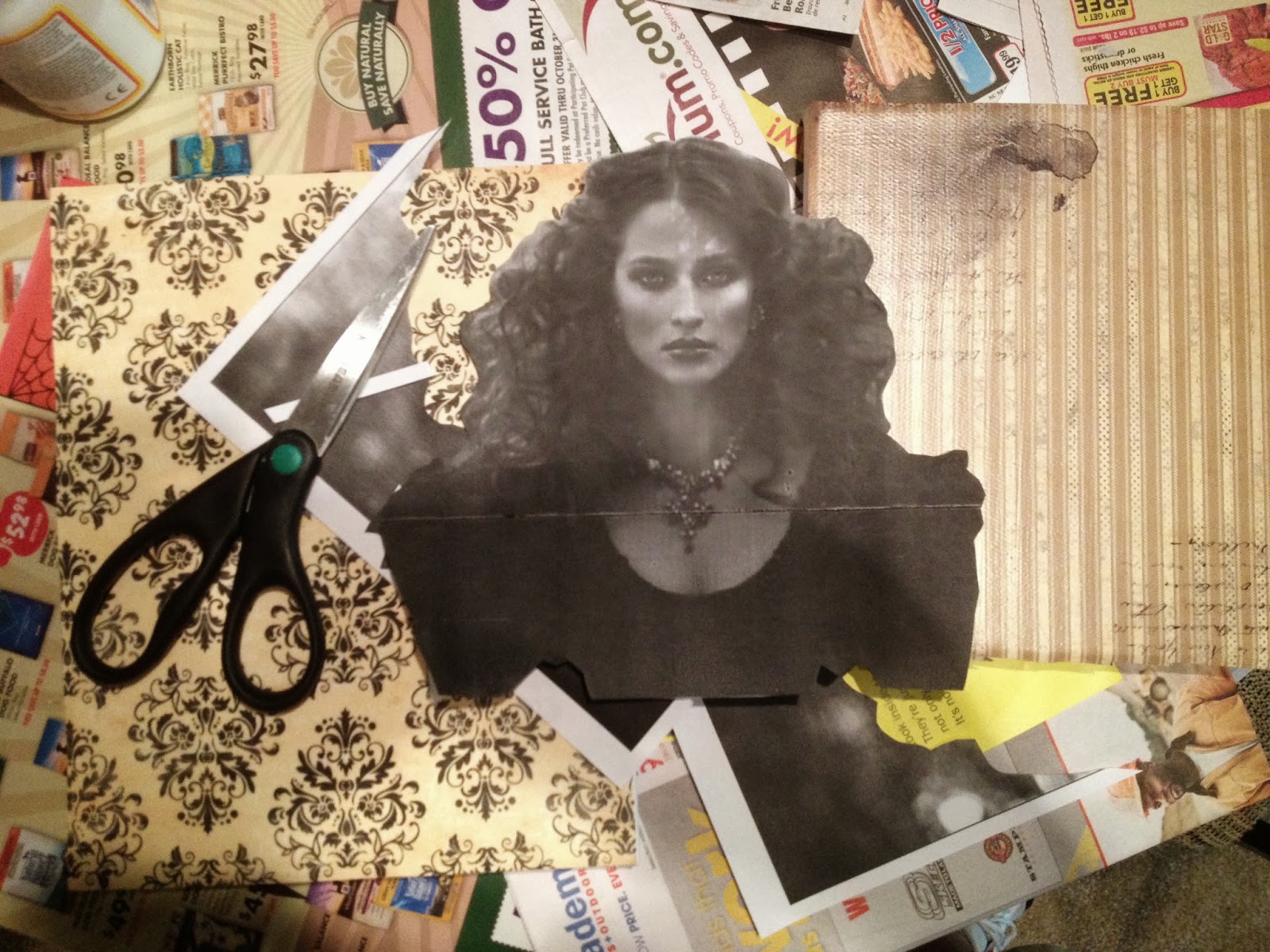
Next step was to print off a predetermined photograph on standard printer paper.  I turned the color photo to black and white so that I could determine for myself what the colors would be.


Cut the background away from the figure.


Decide where on the canvas to collage the photo. - Composition


Before collaging the photo on, I painted the background with a thin layer of gold paint to increase contrast after the black and white photo is applied.


Using Mod Podge I collaged the photo onto the canvas. 
I left the face uncovered to experiment with the paint on paper instead of paint on acrylic surface.


I used Mod Podge, but Golden Brand's Matt medium would have been better.


 I like it already.


Now to start the painting process.

Palette:
titanium white
carbon black
green gold
magenta
yellow ochre


I started with the eyes, then added layers of paint thinly to get multiple varieties of flesh tone.  


I surprised myself with how my green gold I would use.  I used a lot of green gold in the shadows.


painted the neck and down the chest. I painted the skin first and would later paint the necklace because you want to paint what ever in the back first.


I painted the necklace with black, white, and green gold. mixing these in various degrees creates a wide range of tints and shades.  These tints and shades create depth and highlights/shadows.


I decided to go crazy with teh hair. Maybe because we're getting close to Halloween, or maybe just because.  The hair colors include:

White
black
magenta
yellow ochre
green gold

Essentially all the colors were used in the hair to tie the piece together. Now all the colors in the face are also in the hair. This common color scheme unifies the piece while pushing the color contrast further than painting black or brown hair.


I painted the sides of the canvas black to finish the canvas.


The finished painting!

Tuesday, September 24, 2013

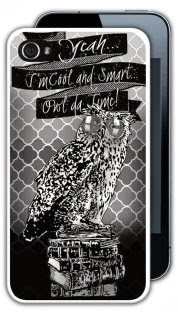
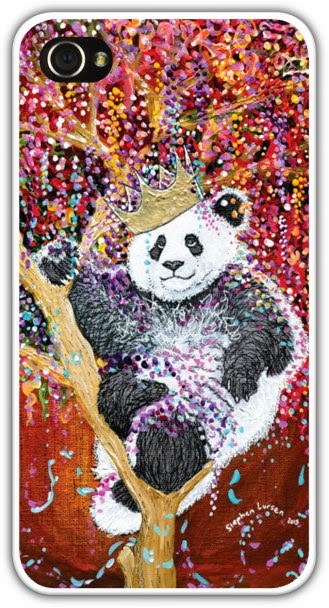
cute animal iphone cases!


I have been working on a batch of iphone cases. Here are a number of images I have finished. Please let me know what you think!

Check out the website for purchasing! Thanks! http://www.donnadowney.com/iphone-cases.html

Sincerely,
Stephen


http://www.donnadowney.com/iphone-cases.html


Friday, August 23, 2013

“The Jerry Saltz Abstract Manifesto, in Twenty Parts."


Dear Jerry,

Over the past few years, I've noticed a lot more abstract art being made, and I often find myself stymied by something a little bit embarrassing. Jerry, is abstract art for real? I mean, I often don't really get it. Isn't it just smudges and stripes and squares and stuff?

—Embarrassed
Dear Embarrassed,
You are not alone. I too have heretical thoughts like yours. It can also take 30 years to understand why an all-white painting by Robert Ryman or a pencil grid on canvas by Agnes Martin is art.
I can't tell you what abstraction is, but I can tell you a number of things that I think that it allows artists to do. What I say about abstract art could also be applied to representational art. With that in mind here's “The Jerry Saltz Abstract Manifesto, in Twenty Parts."

1. Abstraction is one of the greatest visionary tools ever invented by human beings to imagine, decipher, and depict the world.

2. Abstraction is staggeringly radical, circumvents language, and sidesteps naming or mere description. It disenchants, re-enchants, detoxifies, destabilizes, resists closure, slows perception, and increases our grasp of the world.

3. Abstraction not only explores consciousness — it changes it.

4. All art is abstract. A painting of a person or a still-life is a two-dimensional representation of three-dimensional reality and therefore infinitely abstract. Whenever an artist sets out to make something it turns into something else that he or she could never have imagined or predicted.

5. Think of an abstract painting as very, very low relief — a thing, not a picture.

6. Abstraction exists in the interstices between the ideal and the real, symbol and substance, the optic and the haptic, imagination and observation.

7. Abstraction brings the world into more complex, variable relations; it can extract beauty, alternative topographies, ugliness, and intense actualities from seeming nothingness.

8. Abstraction, like ideas, intuitions, feelings, and life, is not mimetic.

9. Abstraction is as old as we are. It has existed for millennia outside the West. It is present on cave walls, in Egyptian and Cypriot Greek art, Chinese scholar rocks, all Islamic and Jewish art — both of which forbid representation. Abstraction is only new in the West.

10. Abstraction gained ground in Western art after centuries of more perfected systems of representation. By the mid-nineteenth century, representation felt like a trap, and seemed empty, false, or limiting. A similar situation existed in the early aughts, after artists of the nineties re-deployed realisms in numerous ways. The field appeared closed off for younger artists. That’s why contemporary artists have not only begun to reexplore the possibilities of abstraction, they’re shedding much of the Greenbergian cant and academic-formalist dogma that attached themselves to it over the last 50 years. Abstraction is breaking free again.

11. Abstraction offers ways around what Beckett called “the neatness of identification.”

12. Rothko’s glowing floating rectangles of color are more than abstract patterns. They are Buddhist TVs or what Keats called “good oblivion. One sees what nothing looks like in them. They make you ask, “What light through yonder painting breaks?” (Now do you see how full emptiness and abstraction can be?)

13. Abstraction is just a tool. It is no less “real” than philosophy or music.

14. Abstraction is something outside of life that allows us to be present at our own absence or alternatively absent in our own presence.

15. Abstraction creates patterns of meaning and its own extremely flexible intricate syntax. It is astral synthesis.

16. Abstraction teeters on making empty gestures while also making deep statements.

17. The camera was supposed to supplant painting but didn't. Instead, painting — ever the sponge, always elastic — absorbed it and discovered new realms.

18. Abstraction may speak in a sort of intra-species visual-electronic-chemical-pheromonal code, creating optical-cerebral networks and wormholes, organic maps of unknown yet familiar territories, may have a kind of plant intelligence that allows it to grow, proliferate, flower, change directions, and survive relentless aesthetic predation from a lay public.

19. Abstraction contains multitudes.

20. I’ve left out No. 20, because I want to hear your opinion: What else does abstraction do that’s special? Comments are open below.

link: http://www.vulture.com/2011/02/ask_an_art_critic_jerry_saltz_7.html?fb_action_ids=10200215583376082&fb_action_types=og.recommends&fb_source=other_multiline&action_object_map=%7B%2210200215583376082%22:10150553999813931%7D&action_type_map=%7B%2210200215583376082%22:%22og.recommends%22%7D&action_ref_map=[]

36"x36" Abstract Painting

I'm teaching a class at Donna Downey Studios on abstract painting and having a blast.  I put myself in the shoes of my first timers and decided to paint outside of what I have done before.
Here are some of the images in progress.  There is still one more 3 hour class to go and I have a few ideas of how I am could to finish it, but to be fair to my students (who don't have access to their paintings) I have to wait till class time to continue painting on this canvas.


This was the end of the first 3 hour class.
I spent the week dreaming up new ideas and feverishly went into action as soon as I finished setting up the class, students were at work, and I could as well.


Same Canvas. This is the end of the 2nd 3 hour class.  One more to go! WHo knows how I will change it next time, I don't! :)
I do like how Zany this painting is, with its 1980's colors and organically softened geometric shapes.
At this point, I would title this painting "Breaking Out".  But its not finished yet...